
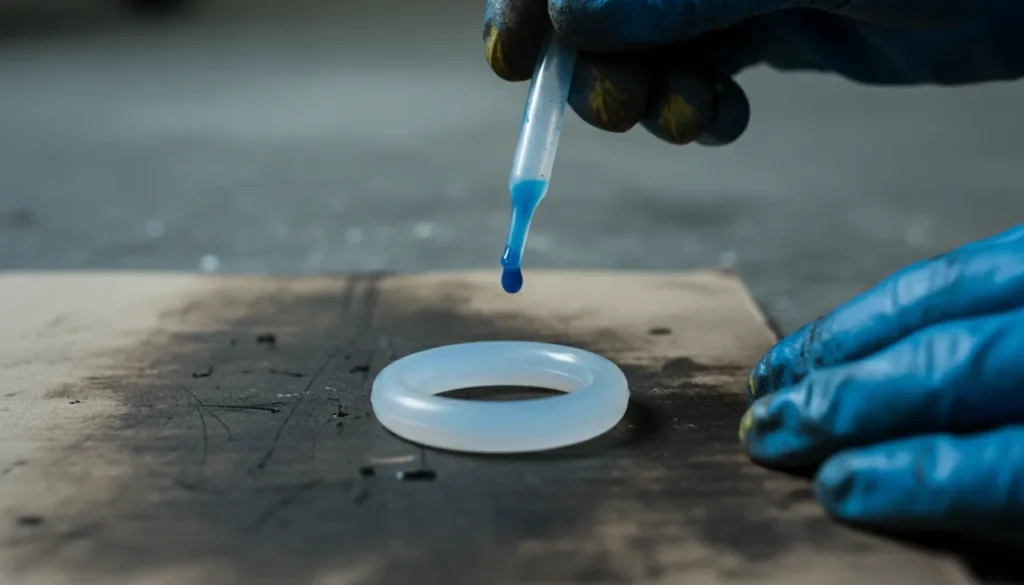
An engineer specs a dense silicone gasket for an enclosure and notices a pressure drop during nitrogen leak testing.
The team assumes the molded part has microscopic surface voids or open pores.
Liquid water does not penetrate the wall, yet tracer gas migrates directly through the cross-section.
Silicone is macroscopically non-porous to bulk liquids, but it is inherently permeable to gases and volatile vapors.
Confusing physical porosity with molecular permeability leads to misdiagnosed seal failures and wasted tooling revisions.
Understanding this distinction determines whether silicone fits your fluid, vacuum, or pressure-boundary assembly.
Does silicone absorb or transmit liquid water?
Dense silicone rubber has no open capillary network and will not transport bulk liquids.
The polymer backbone consists of repeating silicon-oxygen bonds flanked by non-polar methyl groups.
These methyl side chains create a strongly hydrophobic surface that repels liquid water.
Water droplets bead on the surface with contact angles typically exceeding 100 degrees.
Under standard atmospheric operating conditions, liquid water cannot wet the surface or wick into the bulk material.
Total water absorption in fully crosslinked solid silicone remains well below one percent by weight over extended immersion.
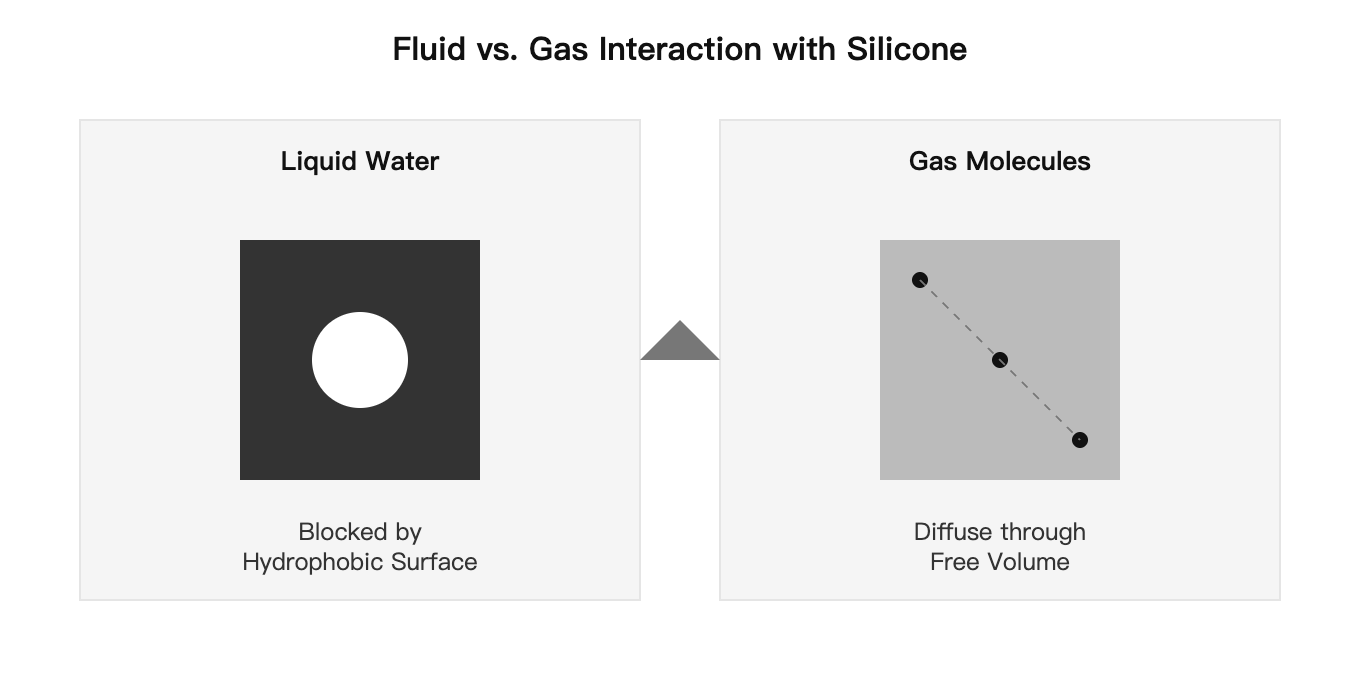
Comparison of liquid water blockage versus gas molecule diffusion through a silicone polymer matrix.
For plant engineers evaluating hydraulic or washdown systems, solid silicone elastomers provide an impenetrable barrier against bulk aqueous fluids.
Why gas migrates through dense silicone rubber
Silicone allows volatile gas molecules to dissolve and diffuse through its polymer matrix.
Because the siloxane backbone exhibits unusually long bond lengths and wide bond angles, the polymer chains remain extremely flexible.
This high chain mobility creates significant free volume between molecules at room temperature.
Gas molecules such as oxygen, nitrogen, carbon dioxide, and helium dissolve into the elastomer on the high-pressure side.
They hop through transient gaps between vibrating polymer chains and desorb on the low-pressure side.
Data on gas exchange membranes confirms that polydimethylsiloxane (PDMS) features higher gas transmission rates than almost any other commercial synthetic elastomer.
Silicone does not leak through pores; it transmits gas via solution-diffusion across the polymer free volume.
If an enclosure requires an absolute hermetic seal against helium or dry air, solid silicone will register as leaking on high-sensitivity mass spectrometers.
How to distinguish porosity from molecular permeation
Permeation rate scales with surface area and inverse wall thickness, whereas true porosity produces localized pressure venting.
A true open pore acts as a physical channel that follows Poiseuille flow, allowing rapid, pressure-driven bulk fluid transit.
Molecular permeation follows Fick’s laws of diffusion and remains governed by solubility and diffusivity constants.
According to technical reviews on silicone surface properties, dense elastomers present zero continuous open channels down to the nanometer scale.
To identify whether a failing seal suffers from permeation or actual structural porosity, evaluate the leak profile across varying conditions:
- Gas leak rates scale linearly with differential pressure during permeation.
- Liquid leakage indicates mechanical bypass, poor gasket compression, or true molding voids.
- Increasing wall cross-section proportionally slows molecular transmission.
- Surface roughness or uncompressed flash leaks instantly along the joint interface.
When gas transmission threatens your assembly, comparing silicone against natural rubber and specialty organics reveals lower-permeability alternatives like butyl or fluoroelastomers.
When does silicone foam or sponge change the porosity equation?
Foamed silicone variants deliberately introduce cell structures that alter fluid and vapor containment.
Engineers frequently select cellular silicone for low-closure-force gaskets, dust seals, and thermal baffles.
However, cellular silicone exists in two distinct mechanical configurations:
Closed-cell silicone sponge
Closed-cell sponge encapsulates separate, non-connecting gas pockets within an elastomer matrix.
Each pocket is bounded by a solid silicone membrane that prevents water and dust from passing through the gasket wall.
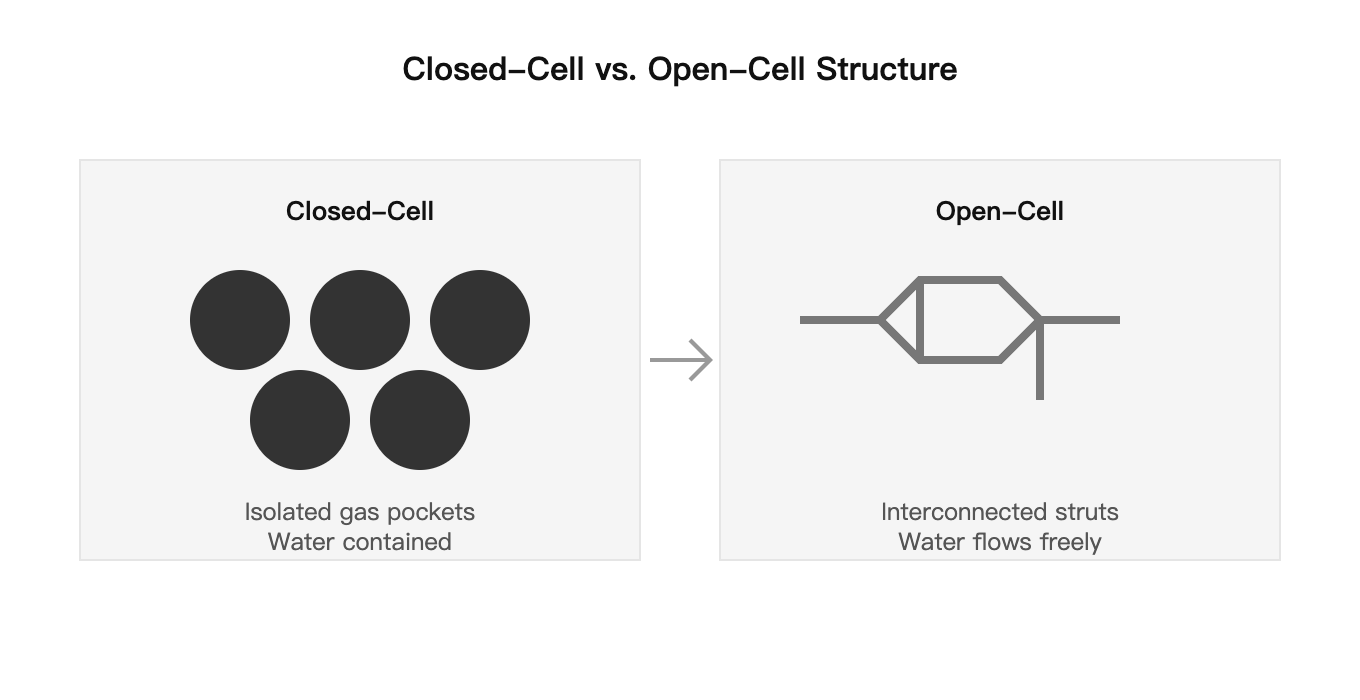
A comparison showing how closed-cell structures isolate gas pockets while open-cell structures allow fluid flow.
It provides reliable environmental sealing against rain, spray, and washdown under moderate flange torque.
Open-cell silicone foam
Open-cell foam consists of interconnected skeletal struts without continuous cell walls.
The interconnected channels absorb liquids like a sponge and allow free air movement.
Using open-cell foam in an outdoor or fluid-containment enclosure guarantees moisture ingress.
How molding defects create false porosity
Incomplete process control during liquid injection or compression molding can produce parts with structural micro-voids.
While the base raw material is non-porous, process failures introduce artificial porosity:
Entrapped air in two-part formulations
Liquid Silicone Rubber (LSR) systems require static mixing of Part A and Part B components.
If the dosing system introduces air bubbles or if vacuum degassing fails, microscopic bubbles stay trapped in the cavity.
These micro-bubbles manifest as sub-surface voids that rupture under line pressure.
Volatile outgassing and post-baking voids
Low-molecular-weight siloxane species and residual crosslinking byproducts volatilize at elevated mold temperatures.
If cavity venting is insufficient, trapped volatiles create blisters or microporous zones along parting lines.
A standardized secondary post-bake cycle removes these residual cyclic compounds and consolidates mechanical density.
Moisture contamination on raw gum stock
High-consistency rubber (HCR) stored in humid environments absorbs surface condensation on raw additives.
During high-temperature press operations, moisture flashes to steam before vulcanization completes.
The resulting steam pockets create permanent micro-fissures across the cross-section.
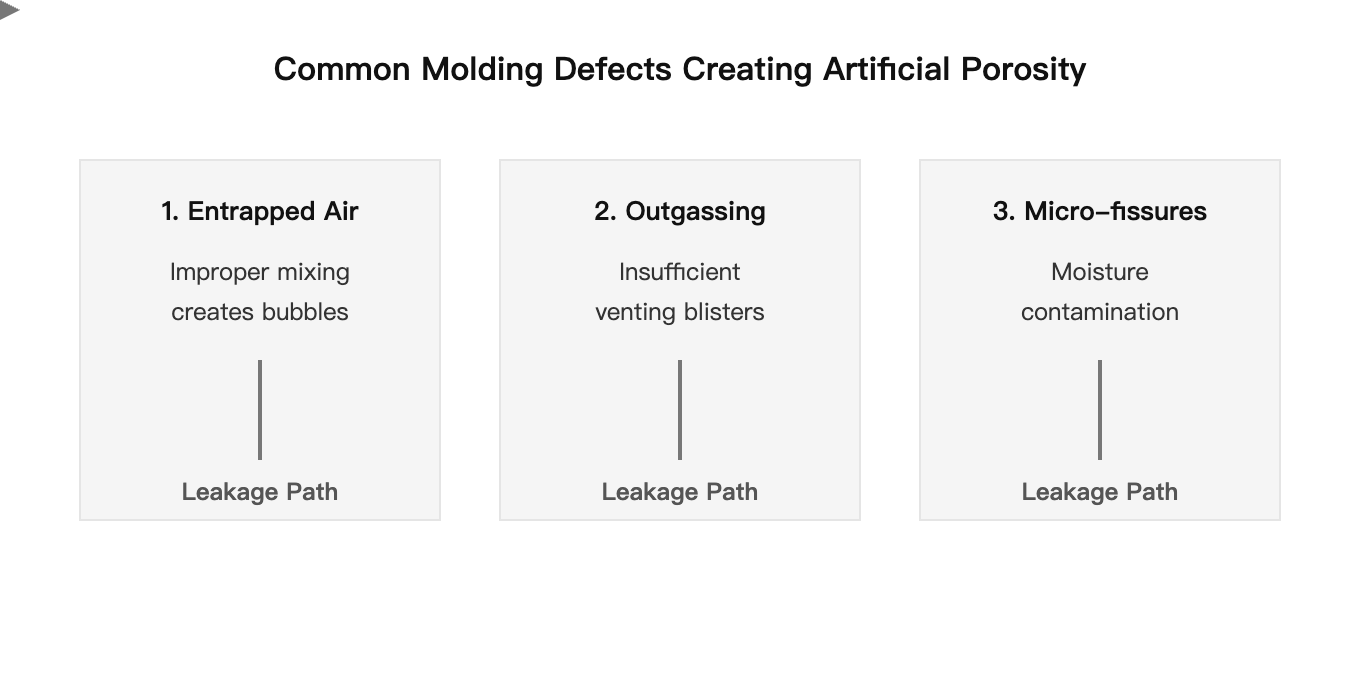
A flow chart illustrating three common molding defects that create leakage paths in materials.
Selecting silicone for hermetic vs fluid containment
Matching silicone to your operating media requires separating bulk fluid barriers from gas-tight boundaries.
Solid silicone excels in IP67 and IP68 enclosures, pump seals, and cleanroom fluid manifolds where water, steam, and polar fluids dominate.
It resists compression set, withstands wide thermal ranges, and prevents liquid wicking.
For high-vacuum chambers, long-term refrigerant containment, or sub-micron pneumatic systems, silicone is usually the incorrect choice due to high diffusion rates.
Specify your material based on target molecule size, internal pressure, and allowable leak rates rather than surface appearance alone.
InSilicone manufactures custom molded silicone, LSR, and dense elastomer components engineered for demanding industrial sealing applications. Contact our engineering team to review your drawing tolerances, request material certifications, or arrange pre-production prototype samples.