
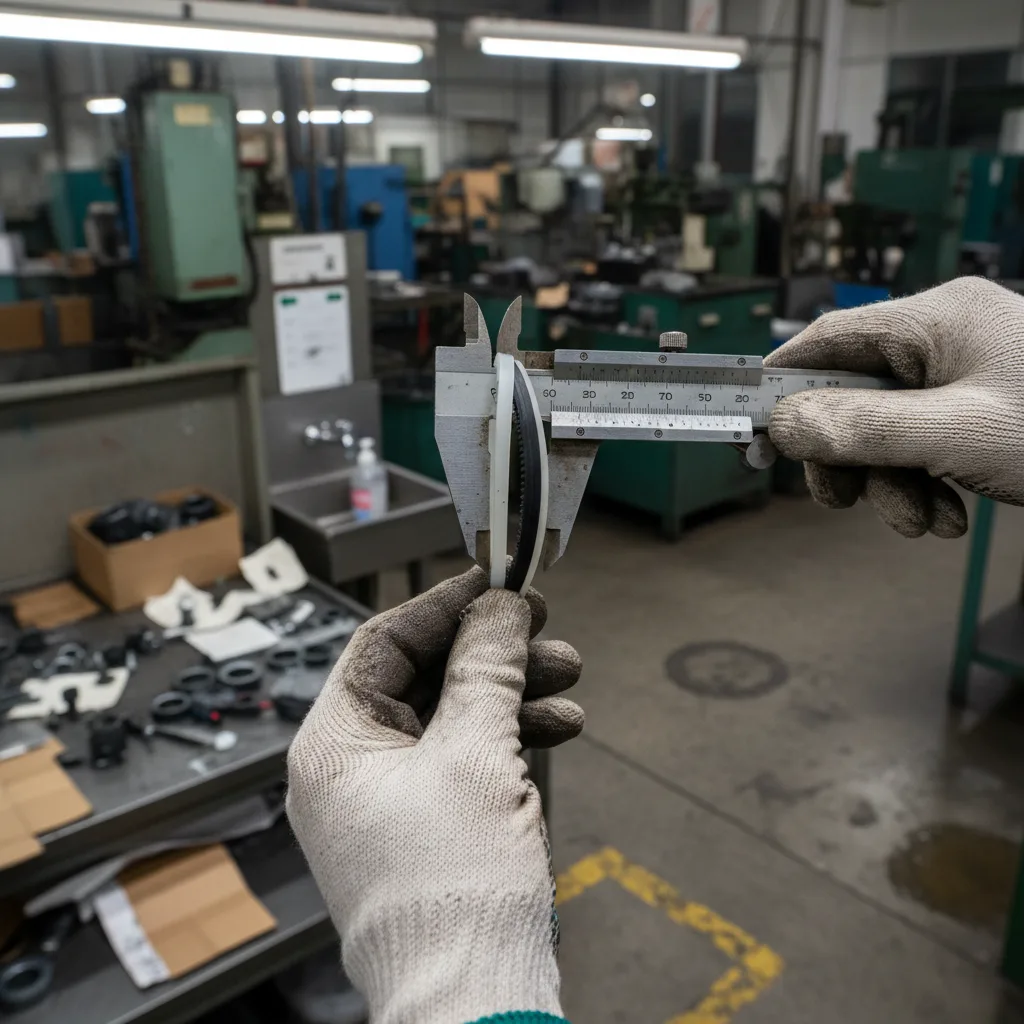
Selecting between thermoplastic elastomers (TPE) and silicone comes down to operating temperature, compression set limits, and production cycle volume.
Silicone maintains elastic recovery from -40°C up to 260°C, making it the standard for high-heat sealing, medical components, and repeated sterilization.
TPE costs less per part in high-volume injection molding and can be re-melted, but it loses tensile strength and creeps rapidly when temperatures exceed 80°C to 100°C.
If your mechanical drawing calls for low compression set under continuous thermal stress, specify silicone over TPE.
Thermal Resistance: Continuous Heat and Low-Temperature Flexibility
Thermal performance is the clearest dividing line between these two materials.
Silicone uses an inorganic silicon-oxygen (Si-O) backbone. This chemical structure gives it exceptional thermal stability across an operating range of -40°C to 260°C. For continuous heat exposure in engine bays, industrial ovens, or autoclave cycles, silicone retains its mechanical properties without softening or off-gassing toxic residues. You can review how this thermal profile compares in specialized designs in our guide on the advantages of using silicone rubber in high-temperature environments.
TPE relies on physical crosslinking between thermoplastic and elastomeric polymer phases. Because it lacks permanent chemical bonds, the material softens as ambient temperatures rise. Most standard TPE formulations degrade or experience severe structural relaxation between 80°C and 125°C. At sub-zero temperatures below -20°C, many TPE grades turn rigid, whereas silicone remains flexible down to -40°C.
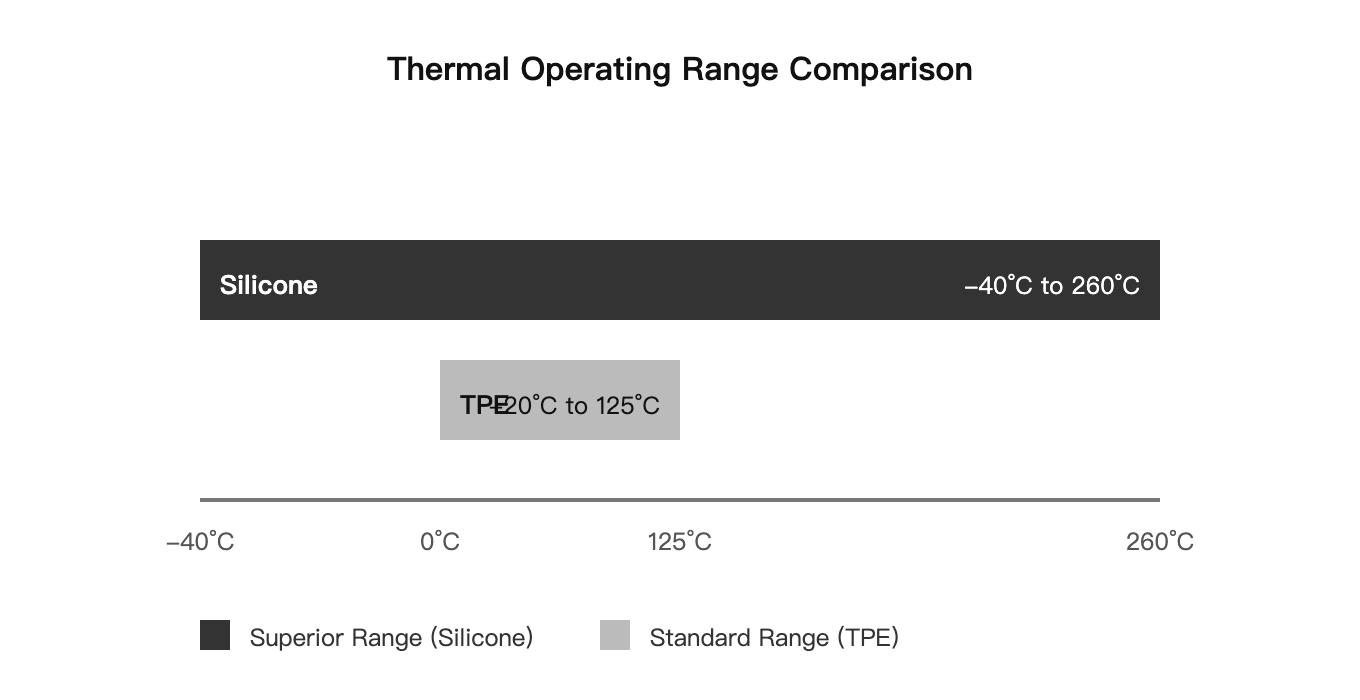
Comparison of continuous service temperature ranges between Silicone and TPE materials.
- Silicone continuous service: -40°C to 200°C+ (specialty grades reach 260°C).
- TPE continuous service: -20°C to 80°C (specialty grades reach 120°C briefly).
- Sterilization compliance: Silicone easily withstands steam autoclave, gamma radiation, and EtO; standard TPEs warp or melt under autoclave heat.
Mechanical Sealing: Compression Set and Creep Over Time
Compression set determines whether a gasket or seal prevents leakage after months under clamp pressure.
Silicone crosslinks permanently during vulcanization. When you compress a liquid silicone rubber (LSR) O-ring by 25% for 1,000 hours at 100°C, it rebounds close to its initial profile once released.
This low compression set makes it ideal for dynamic valves, automotive environmental seals, and electronic enclosure gaskets.
According to engineering data from Kraiburg TPE, TPE exhibits significant cold flow and creep under sustained loads. When exposed to mechanical stress at elevated temperatures, the physical crosslinks in TPE rearrange. The seal takes a permanent set, causing contact pressure to drop and joints to leak.
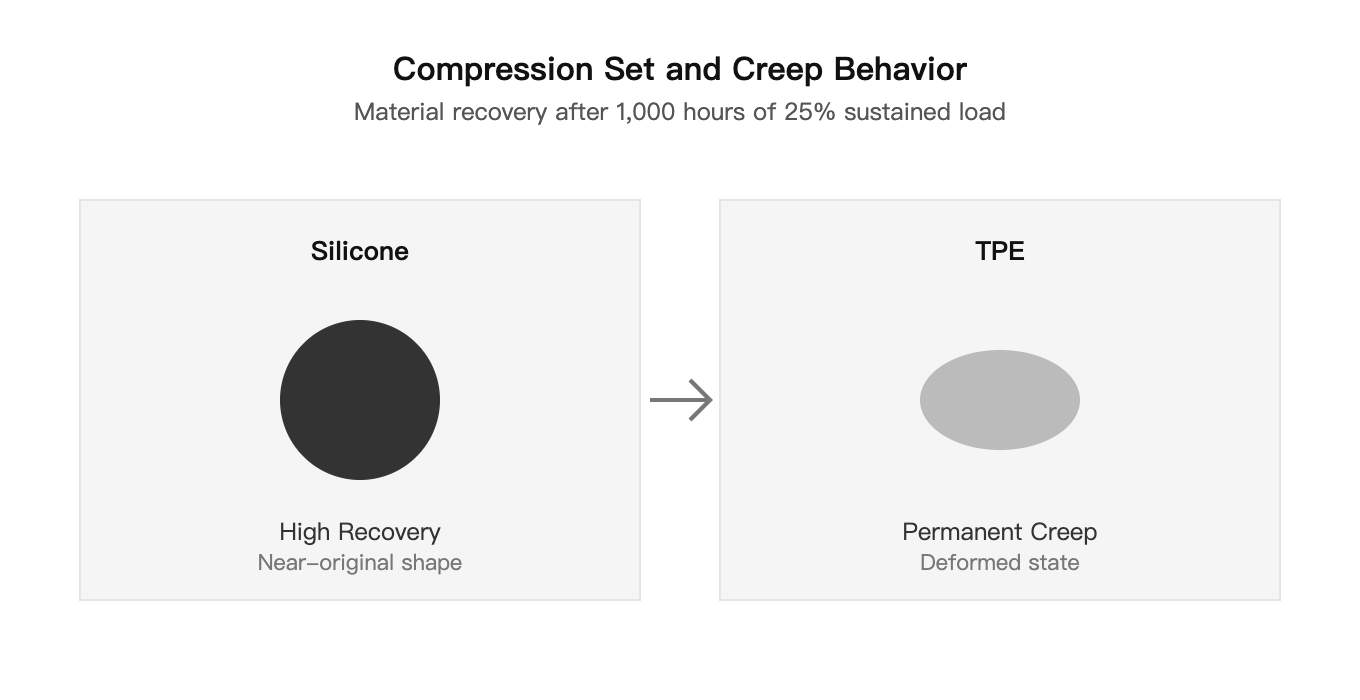
Comparison of material recovery between Silicone and TPE after 1,000 hours of sustained compression.
Use silicone when the drawing demands:
- Compression set below 20% to 30% after continuous heat exposure.
- Consistent sealing force over a multi-year product lifespan.
- High tear strength paired with rapid elastic rebound after flex cycles.
Specify TPE when:
- The part is a static grommet, handle grip, or dust cover.
- Operating temperatures stay near ambient room conditions.
- The application allows for relaxation without catastrophic fluid bypass.
Manufacturing Processes: Tooling Cost and Cycle Times
Your choice between TPE and silicone dictates factory equipment, tooling steel, and per-unit cycle time.
TPE Processing
TPE behaves like a conventional thermoplastic. It melts inside an injection barrel and solidifies inside a chilled mold cavity.
- Cycle times: Fast, typically 15 to 45 seconds depending on wall thickness.
- Tooling requirements: Standard tool steel without dedicated heating elements.
- Scrap management: Runners and sprues can be reground and recycled back into production, cutting raw material waste.
Silicone Processing
Silicone—especially Liquid Silicone Rubber (LSR)—is a two-part liquid system mixed under cold conditions and injected into an electrically heated mold cavity. Heat triggers platinum-catalyzed vulcanization inside the tool. For deeper technical parameters on tooling setups, see our review of advancements in liquid silicone rubber injection molding techniques.
- Cycle times: 30 to 90 seconds, tied directly to the vulcanization kinetics of part thickness.
- Tooling requirements: Precision-machined cavities with vacuum seals to prevent air traps, paired with dedicated heating cartridges.
- Scrap management: Chemically irreversible. Flash and trimmed runners cannot be re-melted.
According to the material analysis by Xometry, while TPE delivers cheaper tooling runs and lower raw resin pricing for commercial consumer items, silicone justifies its tooling investment through tighter dimensional tolerances and flash-free precision across technical geometries.
Biocompatibility and Chemical Resistance Specs
Material selection for medical, fluid-handling, and electrical housings must address chemical attack and biological safety.
Silicone contains no plasticizers that can leach into sensitive fluid streams. This makes it the preferred material for infant care nipples, respiratory diaphragms, and pharmaceutical transfer tubes. TPE formulations often rely on process oils to reach soft durometers (below 30 Shore A), creating an extraction risk during clean-in-place (CIP) regimens or exposure to harsh solvents.
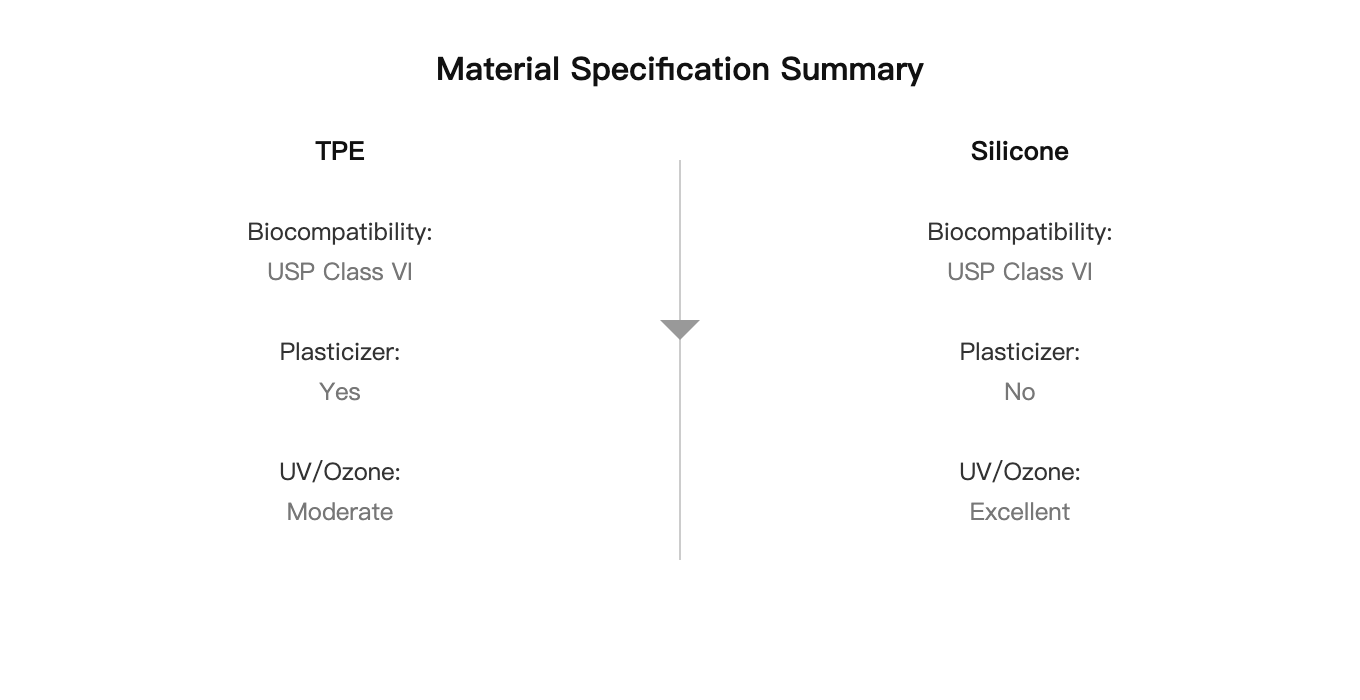
A side-by-side comparison of TPE and Silicone material properties.
When to Select Silicone Over TPE for Your Drawing
Choose silicone when your product specification lists any of the following parameters:
- Continuous operational temperatures above 100°C or below -20°C.
- Exposure to steam sterilization, gamma radiation, or repetitive dishwashing heat cycles.
- Tight tolerance elastomeric seals requiring low compression set under clamp loads.
- Demands for zero plasticizer migration into human tissue or consumable fluids.
- Long-term outdoor installation demanding 10+ years of ozone, rain, and UV resistance without surface crazing.
Choose TPE only when parts remain at room temperature, volume demands rapid short-cycle molding, and the bill of materials cannot absorb silicone tooling or cycle-time costs.
InSilicone provides tailored silicone material formulation, mold fabrication, and LSR injection production for medical, automotive, and electronic components. Contact our engineering team for free samples and design consultations on your custom elastomer drawings.